An illustrated handbook of data structures and algorithms. Every chapter is an animation you scroll through at your own pace, written from primary sources and cited by DOI.
Published chapters
30 of 404 planned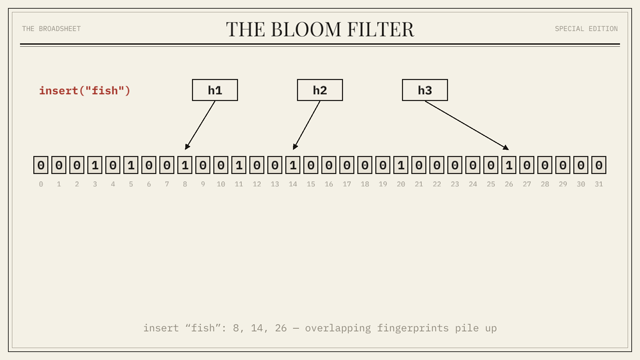
Bloom Filter
Probabilistic membership: probably yes, definitely no.
Read chapter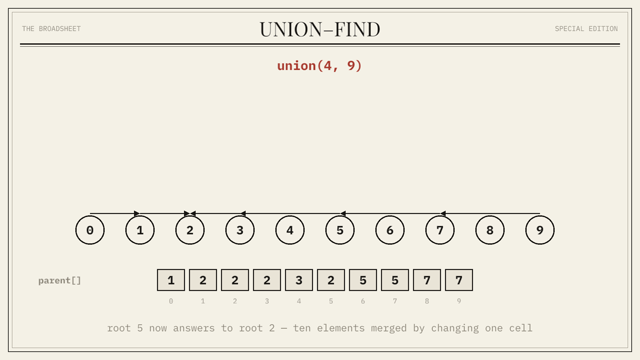
Union-Find
Merge sets, compress paths, answer connectivity fast.
Read chapter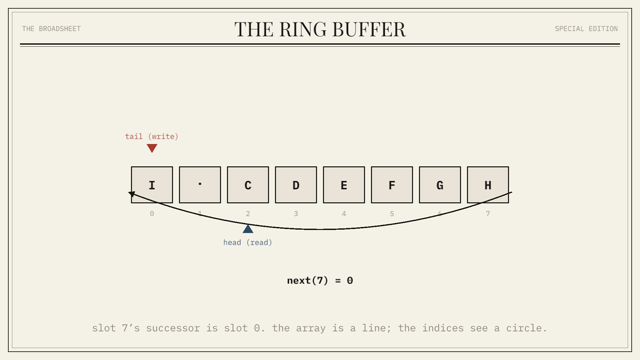
Ring Buffer
Fixed-size queues for streams, logs, and low-latency systems.
Read chapter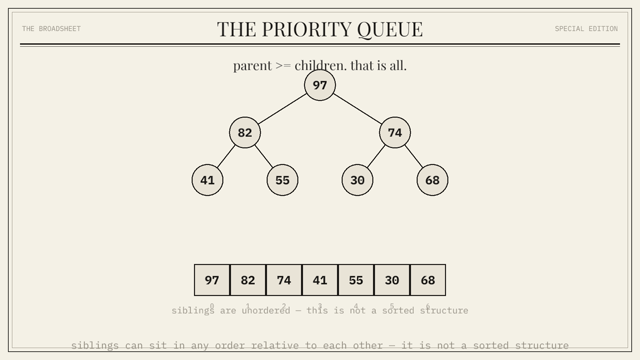
Priority Queue
Always pull the highest-priority item next.
Read chapter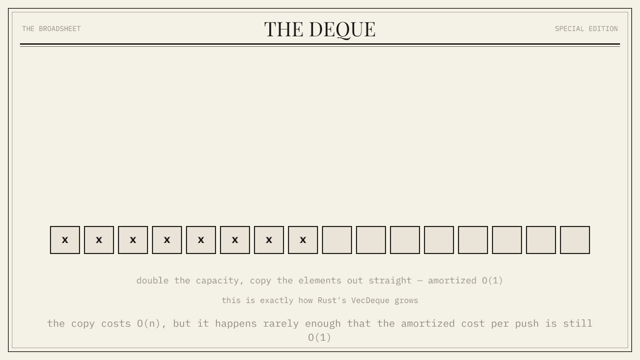
Deque
Push and pop efficiently from both ends.
Read chapter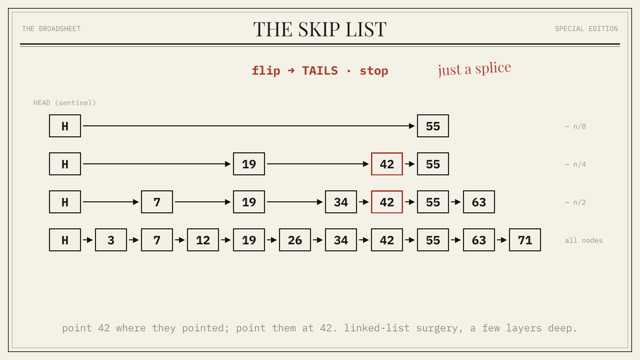
Skip List
Ordered search with coin-flip express lanes.
Read chapter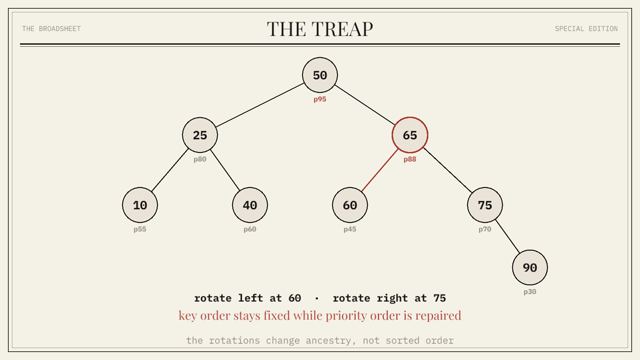
Treap
A randomized binary search tree with heap priorities.
Read chapter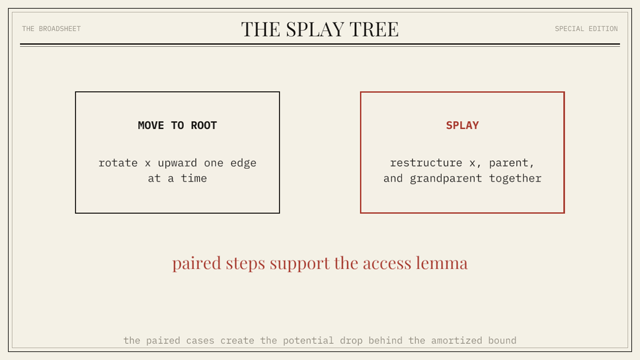
Splay Tree
A search tree shaped by the keys accessed most recently.
Read chapter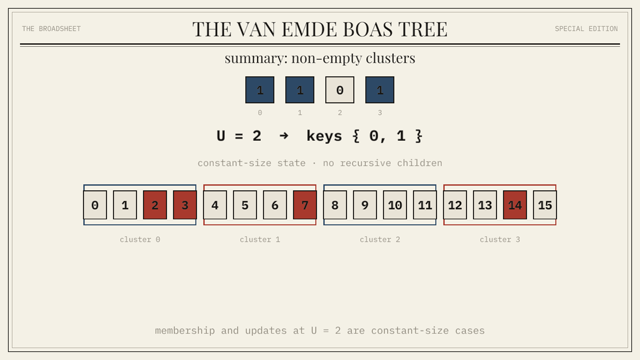
Van Emde Boas Tree
Integer-key operations in doubly logarithmic time.
Read chapter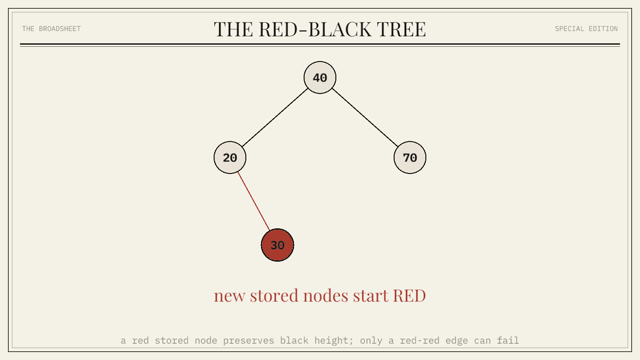
Red-Black Tree
Balanced search with strict coloring invariants.
Read chapter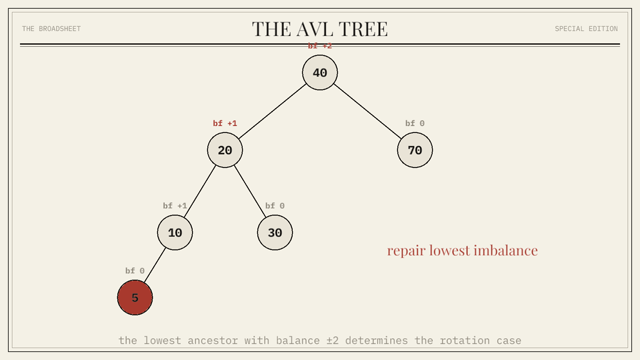
AVL Tree
Height-balanced search with strict local invariants.
Read chapter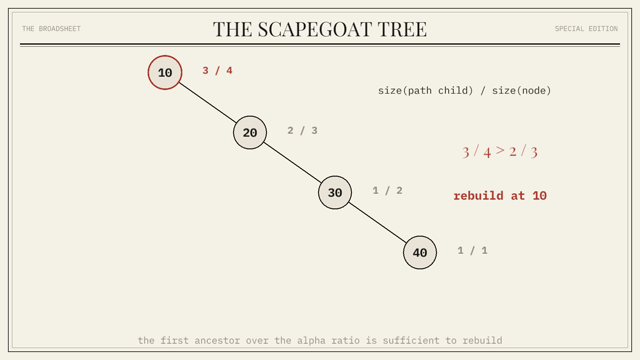
Scapegoat Tree
Rebuild unbalanced subtrees instead of storing balance metadata.
Read chapter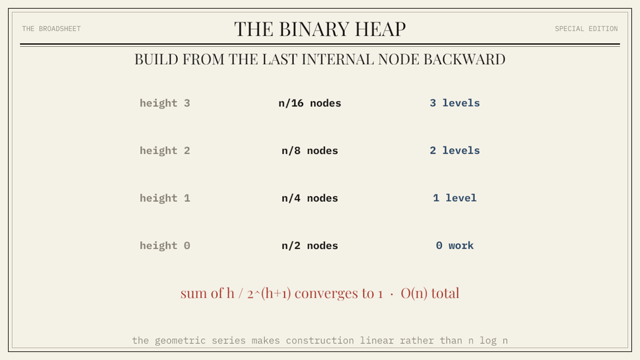
Binary Heap
The compact array-backed priority queue.
Read chapter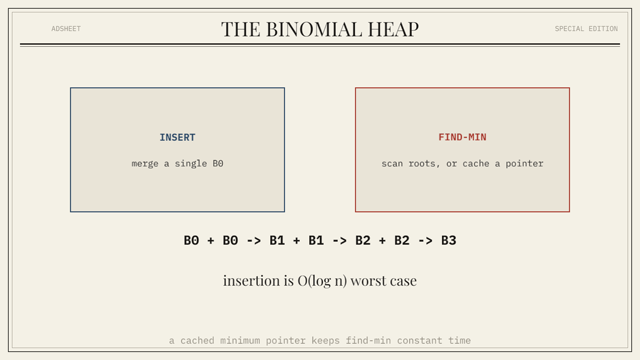
Binomial Heap
A forest of power-of-two heaps built for merging.
Read chapter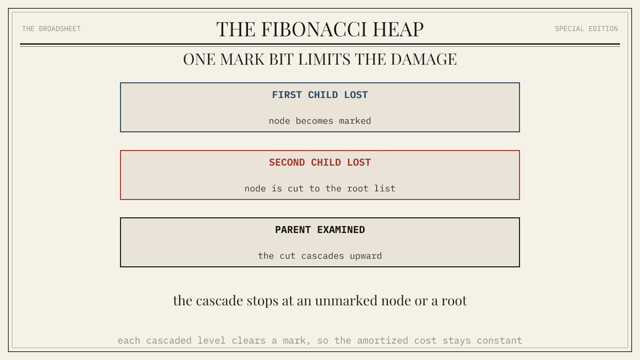
Fibonacci Heap
Lazy merging with excellent amortized graph operations.
Read chapter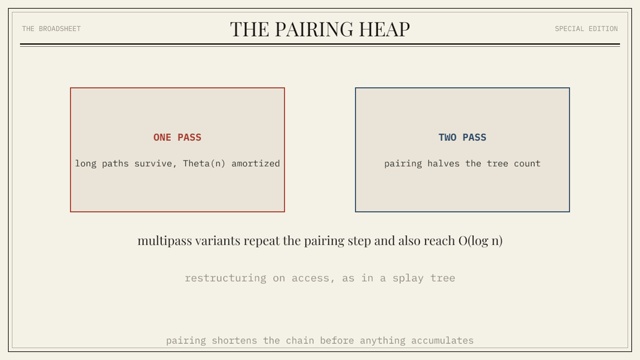
Pairing Heap
A practical meldable heap with simple pointer structure.
Read chapter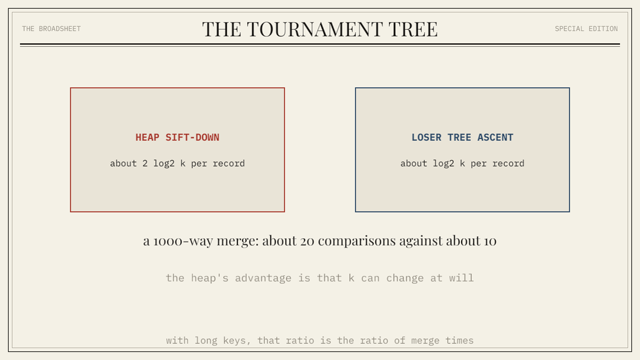
Tournament Tree
Keep winners visible while merging many sorted streams.
Read chapter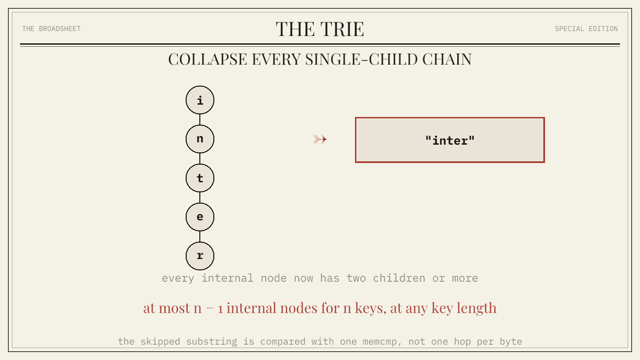
Trie
Prefix search, autocomplete, routing tables, and dictionaries.
Read chapter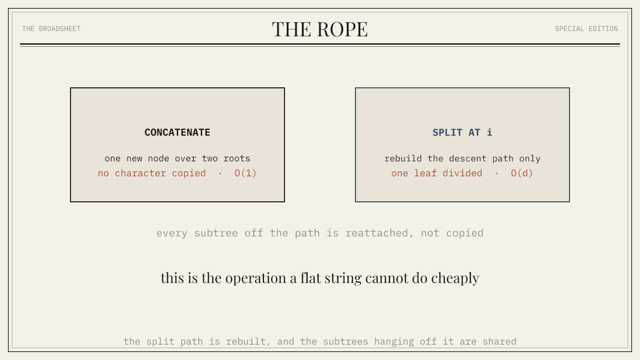
Rope
A text buffer structure for large editable documents.
Read chapter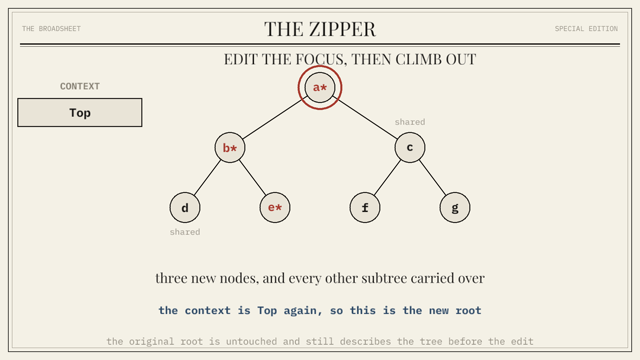
Zipper
Navigate and edit immutable trees with local focus.
Read chapter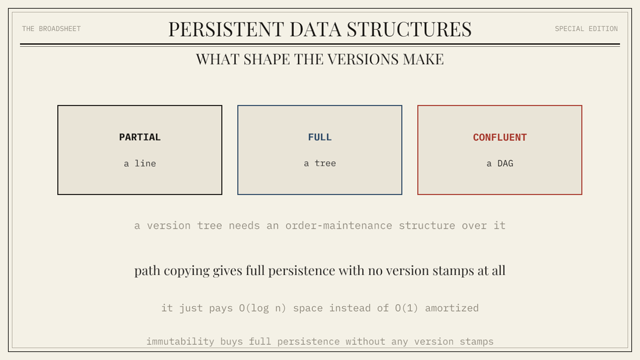
Persistent Data Structures
Update a structure and keep every earlier version queryable.
Read chapter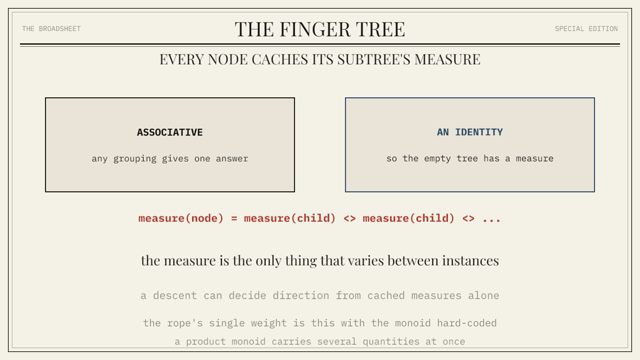
Finger Tree
Cheap ends, logarithmic split, and one annotation that decides the rest.
Read chapter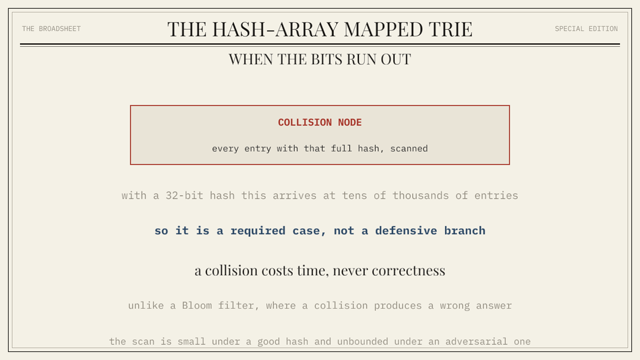
HAMT
Hash-array mapped tries for persistent maps and sets.
Read chapter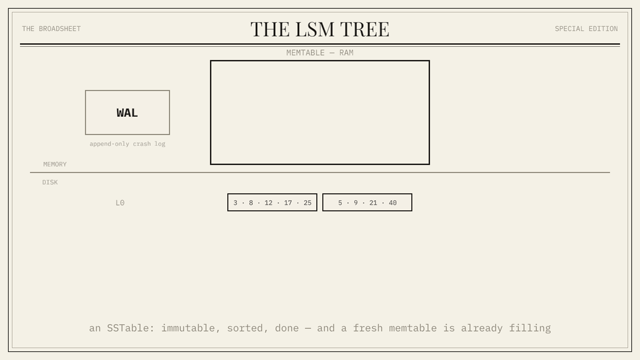
LSM Tree
Append now, sort in memory, merge the debt later.
Read chapter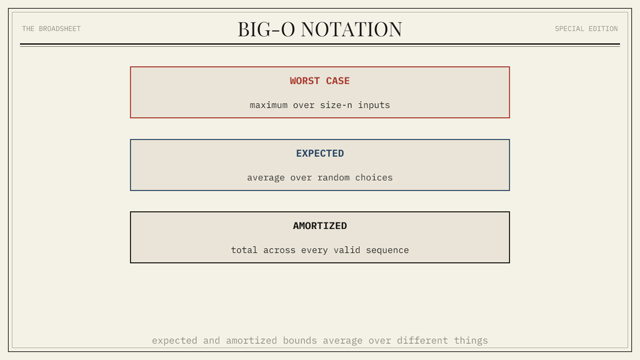
Big-O Notation
Describe growth rates without counting machine cycles.
Read chapter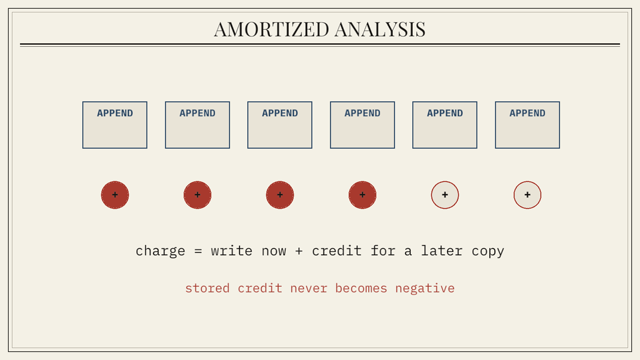
Amortized Analysis
Charge expensive operations against the cheap ones around them.
Read chapter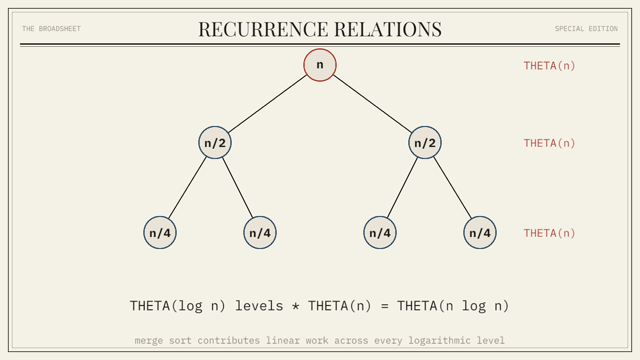
Recurrence Relations
Solve the cost of algorithms that call themselves.
Read chapter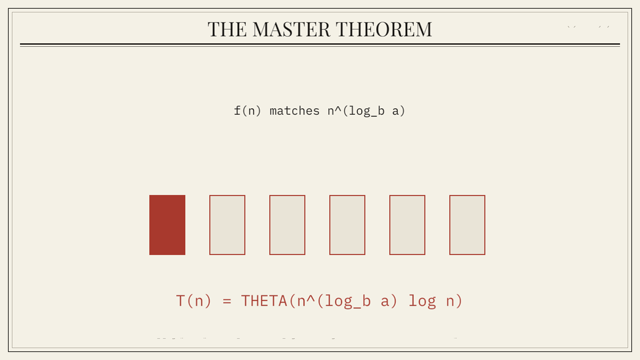
Master Theorem
Read off the complexity of divide-and-conquer recurrences.
Read chapter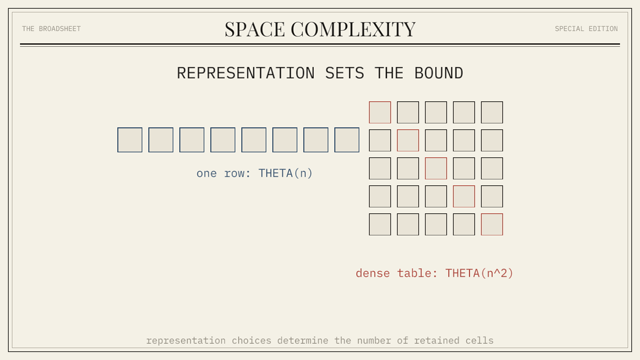
Space Complexity
Account for auxiliary memory, not just running time.
Read chapter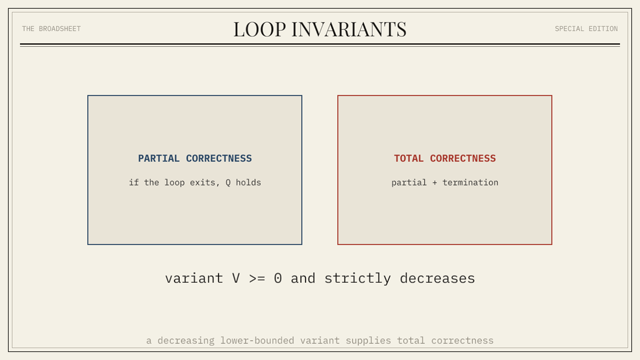
Loop Invariants
Prove a loop correct by stating what never changes.
Read chapterPart One
Data Structures
How data is arranged in memory and on disk, and what each arrangement costs.
Vol. I
Foundations
The small structures that show up everywhere else.
23 published 23 topics
Vol. I
Foundations
The small structures that show up everywhere else.
Sets, Queues, And Membership
- Bloom Filter Probabilistic membership: probably yes, definitely no.
- Union-Find Merge sets, compress paths, answer connectivity fast.
- Ring Buffer Fixed-size queues for streams, logs, and low-latency systems.
- Priority Queue Always pull the highest-priority item next.
- Deque Push and pop efficiently from both ends.
Ordered Search Structures
- Skip List Ordered search with coin-flip express lanes.
- Treap A randomized binary search tree with heap priorities.
- Splay Tree A search tree shaped by the keys accessed most recently.
- Van Emde Boas Tree Integer-key operations in doubly logarithmic time.
- Red-Black Tree Balanced search with strict coloring invariants.
- AVL Tree Height-balanced search with strict local invariants.
- Scapegoat Tree Rebuild unbalanced subtrees instead of storing balance metadata.
Heaps And Merge Structures
- Binary Heap The compact array-backed priority queue.
- Binomial Heap A forest of power-of-two heaps built for merging.
- Fibonacci Heap Lazy merging with excellent amortized graph operations.
- Pairing Heap A practical meldable heap with simple pointer structure.
- Tournament Tree Keep winners visible while merging many sorted streams.
Text And Functional Structures
- Trie Prefix search, autocomplete, routing tables, and dictionaries.
- Rope A text buffer structure for large editable documents.
- Zipper Navigate and edit immutable trees with local focus.
- Persistent Data Structures Update a structure and keep every earlier version queryable.
- Finger Tree Cheap ends, logarithmic split, and one annotation that decides the rest.
- HAMT Hash-array mapped tries for persistent maps and sets.
Vol. II
Databases
Indexes, logs, filters, and storage layouts behind real engines.
1 published 32 topics
Vol. II
Databases
Indexes, logs, filters, and storage layouts behind real engines.
Write-Heavy Storage
- LSM Tree Append now, sort in memory, merge the debt later.
- Write-Ahead Log Durability before mutation: the recovery backbone.
- Bitcask / Hash Index Append-only files with an in-memory key directory.
Advanced Write-Heavy Indexes
- Cuckoo Filter A deletable membership filter for storage engines.
- Bloom Filter Cascade Layered filters for multi-level LSM lookups.
- Masstree A cache-conscious trie of B+ trees for modern hardware.
- Log-Structured Merge Forest Many LSMs working together instead of one tree.
- Fractal Tree Index Buffer updates inside a tree to reduce random writes.
- Bw-Tree A latch-free B-tree variant built from delta records.
Read-Heavy Storage
- B+ Tree The classic page-oriented index for range scans.
- B-tree vs LSM Tree Why reads, writes, and compaction trade places.
- Roaring Bitmap Compressed posting lists and fast set operations.
- Segment Tree Range queries with logarithmic updates.
- Fenwick Tree Compact prefix sums for mutable numeric data.
- Zone Map Skip blocks by storing min/max summaries per chunk.
- Sparse Index Index representative keys instead of every row.
Columnar And Analytical Layouts
- Column Store Store each field separately for scans and compression.
- Dictionary Encoding Replace repeated values with compact integer ids.
- Run-Length Encoding Compress repeated values as value and count pairs.
- Bitmap Index Use bitsets to answer analytical filters quickly.
Caches And Memory Indexes
- LRU Cache Evict the least recently touched item.
- LFU Cache Evict by access frequency instead of recency.
- ARC Cache Balance recent and frequent access patterns adaptively.
- Clock Cache Approximate LRU with a circular reference-bit scan.
- Slab Allocator Group fixed-size allocations for predictable memory reuse.
Search And Vector Indexes
- TF-IDF / BM25 The scoring model behind practical keyword search.
- Suffix Array / Suffix Tree Substring search without scanning every character.
- Aho-Corasick Automaton Match many patterns in one pass.
- HNSW Graph Approximate nearest-neighbor search at scale.
- Locality-Sensitive Hashing Put similar vectors into the same buckets.
- IVF Index Partition vector space into coarse clusters before search.
- Product Quantization Compress vectors into codebooks for fast approximate search.
Vol. III
Distributed Systems
Data representations for partitioning, causality, replication state, and distributed logs.
19 topics
Vol. III
Distributed Systems
Data representations for partitioning, causality, replication state, and distributed logs.
Partitioning And Placement
- Hash Ring Represent key ownership around a circular token space.
- Partition Map Map key ranges or shards to replica owners.
- Virtual Nodes Smooth load across uneven machines in a hash ring.
- Shard Map Route keys through an explicit partition ownership table.
Replica State
- Merkle Tree Compare replica state by hashing whole subtrees.
- Replica Set Represent the nodes responsible for each shard copy.
- Replication Log Store ordered state changes for followers to replay.
Time, Causality, And Ordering
- Vector Clock Track causal order without one global clock.
- Lamport Clock Create a partial ordering of events with counters.
- Hybrid Logical Clock Blend physical time with causal ordering.
- Version Vector Track per-replica versions for conflict detection.
Conflict-Free Collaboration
- CRDT A family of mergeable replicated data structures.
- Causal Tree Represent collaborative text as ordered causally linked inserts.
- Last-Writer-Wins Register A simple conflict rule with sharp tradeoffs.
- Observed-Remove Set A CRDT set that makes adds and removes mergeable.
Queues, Logs, And Streams
- Partitioned Commit Log Scale ordered event storage across independent partitions.
- Consumer Offset Index Track per-reader progress through an append-only log.
- Delay Queue Release work only after its scheduled time arrives.
- Dead Letter Queue Preserve failed messages for diagnosis and replay.
Vol. IV
Spatial And Geometry
Indexes and representations for points, polygons, maps, and collision worlds.
18 topics
Vol. IV
Spatial And Geometry
Indexes and representations for points, polygons, maps, and collision worlds.
Point And Region Indexes
- KD-tree Split space by alternating coordinate axes.
- Quadtree / R-tree Partition or bound space for map and region queries.
- Interval Tree Find overlapping ranges efficiently.
- Geohash Encode nearby coordinates with shared prefixes.
- S2 Cell Index the globe with hierarchical cells on a projected cube.
- H3 Hex Index Represent Earth with hierarchical hexagonal cells.
Collision And Acceleration Structures
- Bounding Volume Hierarchy Nested boxes for fast intersection tests.
- BSP Tree Recursively split space with planes for visibility and collision.
- AABB Tree Maintain axis-aligned boxes for dynamic collision worlds.
- Spatial Hash Grid Bucket nearby objects by grid cell for broad-phase queries.
Planar Geometry Structures
- Voronoi Diagram Divide space by nearest site.
- Delaunay Triangulation Connect points into well-shaped triangles.
- Arrangement Store vertices, edges, and faces induced by curves or segments.
- Quad-Edge Represent primal and dual planar subdivisions together.
Mesh And Polygon Representation
- Half-Edge Data Structure Store mesh adjacency for traversal and editing.
- DCEL A planar subdivision structure for faces, edges, and vertices.
- Winged-Edge Mesh Store rich edge adjacency for manifold surfaces.
- Face-Vertex Mesh Store geometry as vertex arrays plus indexed faces.
Vol. V
Graphics Programming
The rendering pipeline from pixels to scenes.
19 topics
Vol. V
Graphics Programming
The rendering pipeline from pixels to scenes.
Rasterization Pipeline
- Z-buffer Depth testing so nearer fragments win.
- Barycentric Coordinates Interpolate values across triangles.
- Anti-Aliasing MSAA, FXAA, and TAA for smoother edges.
- G-buffer Store per-pixel material and geometry data for deferred rendering.
GPU Programs And Surfaces
- Shader Vertex and fragment programs in the GPU pipeline.
- Texture Mapping / UVs Wrap images onto mesh surfaces.
- Normal Mapping Fake surface detail by perturbing normals.
- Signed Distance Field Represent shapes by distance to the nearest surface.
Scene Organization And Visibility
- Scene Graph Represent transforms and hierarchy in a world.
- Level-of-Detail Hierarchy Store alternate mesh resolutions for distance-based rendering.
- Portal Graph Represent visible room-to-room connections in indoor scenes.
Lighting And Render Architecture
- Ambient Occlusion Darken creases where nearby geometry blocks light.
- Deferred vs Forward Rendering Choose where lighting work happens.
- Global Illumination Model indirect light bouncing through a scene.
- Lightmap Store baked lighting in texture space.
Curves, Volumes, And Transforms
- Bezier Curves / B-splines Smooth curves for paths, fonts, and animation.
- Quaternion Represent 3D rotation without Euler angle traps.
- Skeletal Animation Drive meshes with bone hierarchies and skin weights.
- Dual Quaternion Skinning Blend rigid transforms with fewer collapsing artifacts.
Vol. VI
Sketches And Approximation
Tiny summaries for huge streams and uncertain answers.
21 topics
Vol. VI
Sketches And Approximation
Tiny summaries for huge streams and uncertain answers.
Probabilistic Summaries
- HyperLogLog Estimate distinct counts in a tiny amount of memory.
- Count-Min Sketch Approximate frequencies in streaming data.
- Cuckoo Filter vs Bloom Filter Membership tests when deletion matters.
- Quotient Filter A compact deletable approximate membership structure.
- Xor Filter Fast static membership filters with low memory overhead.
- T-Digest Approximate quantiles accurately at distribution tails.
- KLL Sketch A compact quantile sketch with strong error bounds.
Time-Series Structures
- Time-Series Chunk Store ordered samples in compressed time-window blocks.
- Delta-of-Delta Series Block Store timestamps as changes in spacing inside compressed blocks.
- Gorilla Block A time-series block layout for timestamp and float compression.
- Downsampling Rollup Precompute coarser windows for long-range queries.
- Retention Tier Index Organize hot, warm, and cold series by age.
- Time-Partitioned B+ Tree Route recent and historical samples through time ranges.
- TSM File Influx-style immutable time-series blocks and indexes.
- LSM Time-Series Layout Use sorted runs optimized for append-heavy metrics.
Stream Windows And Heavy Hitters
- Sliding Window Counter Track recent activity without storing every event.
- Exponential Histogram Approximate counts over a moving time window.
- Heavy-Hitter Summary Track dominant keys in high-volume streams with bounded memory.
- Reservoir Sample Store a representative sample from an unknown stream.
- Misra-Gries Summary Track frequent items with bounded counters.
- Lossy Counting Summary Store approximate frequent items over stream buckets.
Vol. VII
Graph Structures
Representations for relationships, dependencies, control flow, and graph-shaped data.
18 topics
Vol. VII
Graph Structures
Representations for relationships, dependencies, control flow, and graph-shaped data.
Graph Representations
- Adjacency List Store sparse graph neighbors compactly.
- Adjacency Matrix Constant-time edge checks for dense graphs.
- Compressed Sparse Row Pack graph edges into arrays for fast traversal.
- Edge List Represent graphs as sortable relationship records.
- Property Graph Attach labels and attributes to nodes and edges.
Graph Families And Components
- Directed Graph Store relationships where edges have orientation.
- Undirected Graph Store symmetric relationships between vertices.
- Directed Acyclic Graph Represent dependencies with no directed cycles.
- Multigraph Allow multiple edges between the same pair of vertices.
- Hypergraph Represent edges that can connect more than two vertices.
Specialized Graph Structures
- Dominator Tree Represent dominance relationships in a control-flow graph.
- SPQR Tree Decompose a graph by its triconnected components.
- Link-Cut Tree Maintain a changing forest with path queries.
- Graph-Structured Stack Share parser stack prefixes across ambiguous parses.
Flow And Constraint Graphs
- Residual Graph Track remaining capacity and reverse corrections in flow.
- Bipartite Matching Graph Pair two sets under compatibility constraints.
- Factor Graph Represent variables and constraints as a bipartite graph.
- Decision Diagram Compactly represent boolean functions as a directed graph.
Vol. VIII
Compilers And Runtimes
Structures that turn source code into execution.
15 topics
Vol. VIII
Compilers And Runtimes
Structures that turn source code into execution.
Parsing And Syntax
- Token Stream The linear structure produced by lexical analysis.
- Parse Tree Represent grammar derivations before semantic cleanup.
- Abstract Syntax Tree The program shape compilers actually transform.
- Pratt Parser Table Encode expression precedence with binding powers.
- Concrete Syntax Tree Preserve source-level syntax details for tooling.
Intermediate Representation
- Control-Flow Graph Represent basic blocks and jumps between them.
- Static Single Assignment Give every value one definition for easier optimization.
- Use-Def Chain Link variable definitions to the places that use them.
- Symbol Table Map names to scopes, types, and declarations.
- Type Environment Track inferred and declared types across scopes.
Runtime Memory
- Call Stack Store frames, locals, returns, and control flow.
- Heap Arena Allocate many objects from large memory regions.
- Free List Track reusable memory blocks after deallocation.
- Heap Object Graph Represent object references for tracing and garbage collection.
- Generational Heap Separate young and old objects for faster collection.
Vol. IX
Networking And Security
Packet paths, identity, integrity, and authenticated storage.
10 topics
Vol. IX
Networking And Security
Packet paths, identity, integrity, and authenticated storage.
Network Lookup And Routing
- Radix Tree Compress prefixes for routing tables and string maps.
- Patricia Trie Bitwise compressed trie for IP prefix lookup.
- Routing Table Choose next hops by destination prefix.
- Connection Table Track active flows by five-tuple keys.
- Token Bucket Rate-limit bursts with refillable capacity.
Cryptographic Structures
- Merkle Tree Authenticate large sets through recursive hashes.
- Merkle Patricia Trie Authenticated key-value storage for blockchain state.
- Sparse Merkle Tree Prove membership in a huge mostly-empty key space.
- Hash Chain Link records so tampering changes every later hash.
- Accumulator Compactly prove set membership with cryptographic witnesses.
Vol. X
Machine Learning And IR
Structures for retrieval, ranking, tensors, and learned representations.
10 topics
Vol. X
Machine Learning And IR
Structures for retrieval, ranking, tensors, and learned representations.
Retrieval Indexes
- Inverted Index Map terms to documents and positions.
- Posting List Store document ids, positions, and term payloads.
- Skip Pointer Jump across long posting lists during intersection.
- FST Term Dictionary Compress sorted terms into a finite-state transducer.
- WAND Index Skip low-scoring documents during top-k retrieval.
Vector And Tensor Layouts
- Embedding Matrix Store learned vector rows for tokens or entities.
- Tensor Strides Map multidimensional indexes onto flat memory.
- Sparse Tensor Store only non-zero coordinates and values.
- Quantized Tensor Pack approximate numeric values into smaller types.
- KV Cache Reuse transformer attention keys and values during generation.
Part Two
Algorithms
What you do with the data once it is arranged: search, sort, traverse, optimise, agree.
Vol. XI
Foundations And Techniques
The analysis vocabulary and the handful of patterns the rest of the book reuses.
6 published 18 topics
Vol. XI
Foundations And Techniques
The analysis vocabulary and the handful of patterns the rest of the book reuses.
Analysis
- Big-O Notation Describe growth rates without counting machine cycles.
- Amortized Analysis Charge expensive operations against the cheap ones around them.
- Recurrence Relations Solve the cost of algorithms that call themselves.
- Master Theorem Read off the complexity of divide-and-conquer recurrences.
- Space Complexity Account for auxiliary memory, not just running time.
- Loop Invariants Prove a loop correct by stating what never changes.
Core Patterns
- Binary Search Halve the search space, and get the boundary cases right.
- Binary Search On Answer Search the result space when the input is not sorted.
- Two Pointers Walk a sequence from both ends to avoid a nested loop.
- Sliding Window Maintain a moving range and update it incrementally.
- Prefix Sums Precompute cumulative totals for constant-time range queries.
- Difference Array Apply many range updates in constant time each.
- Divide And Conquer Split, solve independently, and combine the halves.
- Meet In The Middle Halve an exponential search by enumerating both sides.
Bit Manipulation
- Bitwise Tricks Masks, shifts, and the identities worth memorising.
- Population Count Count set bits without looping over them.
- Subset Enumeration Iterate every submask of a bitmask efficiently.
- Gray Code Order values so consecutive entries differ by one bit.
Vol. XII
Sorting And Selection
Putting things in order, and finding the k-th item without bothering.
20 topics
Vol. XII
Sorting And Selection
Putting things in order, and finding the k-th item without bothering.
Comparison Sorts
- Quicksort Partition around a pivot and recurse on both sides.
- Merge Sort Sort halves independently and merge them in linear time.
- Heapsort Build a heap, then repeatedly extract the maximum.
- Insertion Sort Grow a sorted prefix one element at a time.
- Selection Sort Repeatedly move the smallest remaining item into place.
- Bubble Sort Swap neighbours until no swaps remain.
- Shell Sort Insertion sort over decreasing gap sequences.
- Comparison Sort Lower Bound Why no comparison sort beats n log n.
Non-Comparison Sorts
- Counting Sort Sort small integer keys by tallying occurrences.
- Radix Sort Sort digit by digit using a stable inner sort.
- Bucket Sort Distribute into ranges, sort each, concatenate.
- Pigeonhole Sort Place keys directly into their own slots.
Production Sorts
- Timsort The adaptive merge sort behind Python and Java.
- Introsort Quicksort that falls back to heapsort on bad pivots.
- Pattern-Defeating Quicksort Detect adversarial and presorted inputs cheaply.
- External Merge Sort Sort data far larger than memory.
- Parallel Sorting Split, sort, and merge across cores.
Selection And Order Statistics
- Quickselect Find the k-th smallest without a full sort.
- Median Of Medians Guarantee a good pivot in linear worst-case time.
- Top-K Selection Keep only the best k items from a large stream.
Vol. XIII
Graph Algorithms
Traversal, shortest paths, spanning trees, connectivity, and flow.
32 topics
Vol. XIII
Graph Algorithms
Traversal, shortest paths, spanning trees, connectivity, and flow.
Traversal
- Breadth-First Search Explore level by level; shortest paths on unweighted graphs.
- Depth-First Search Follow each branch to exhaustion and backtrack.
- Topological Sort Order a DAG so every edge points forward.
- Cycle Detection Find cycles in directed and undirected graphs.
- Bipartite Check Two-colour a graph, or prove you cannot.
- Flood Fill Expand through a connected region of a grid.
Shortest Paths
- Dijkstra's Algorithm Greedy shortest paths with non-negative weights.
- Bellman-Ford Handle negative weights and detect negative cycles.
- Floyd-Warshall All-pairs shortest paths by dynamic programming.
- A* Search Guide the search with an admissible heuristic.
- Bidirectional Search Search from both endpoints and meet in the middle.
- Johnson's Algorithm All-pairs shortest paths on sparse weighted graphs.
- 0-1 BFS Shortest paths when every edge costs zero or one.
Spanning Trees And Connectivity
- Kruskal's Algorithm Build a minimum spanning tree edge by edge.
- Prim's Algorithm Grow a minimum spanning tree from one vertex.
- Borůvka's Algorithm Merge components in parallel rounds.
- Tarjan's SCC Algorithm Find strongly connected components in one pass.
- Kosaraju's Algorithm Two traversals, one on the reversed graph.
- Bridges And Articulation Points Find the edges and vertices that hold a graph together.
- Lowest Common Ancestor Answer ancestor queries with binary lifting or Euler tours.
Flow And Matching
- Ford-Fulkerson Augment along paths until no capacity remains.
- Edmonds-Karp Ford-Fulkerson with shortest augmenting paths.
- Dinic's Algorithm Level graphs and blocking flows for faster max flow.
- Min-Cut Max-Flow Why the smallest cut equals the largest flow.
- Hopcroft-Karp Maximum bipartite matching in near-linear time.
- Hungarian Algorithm Optimal assignment under a cost matrix.
- Min-Cost Max-Flow Push maximum flow at the lowest total cost.
Graph Ranking And Traversal Paths
- PageRank Rank nodes by the random surfer stationary distribution.
- HITS Separate hubs from authorities in a link graph.
- Eulerian Path Walk every edge exactly once.
- Hamiltonian Path Visit every vertex once, and why it is hard.
- Travelling Salesman Exact and approximate tours of every city.
Vol. XIV
Dynamic Programming
Recognising overlapping subproblems, and the classic recurrences worth knowing by heart.
22 topics
Vol. XIV
Dynamic Programming
Recognising overlapping subproblems, and the classic recurrences worth knowing by heart.
Method
- Memoization vs Tabulation Top-down and bottom-up, and when each is clearer.
- State Design Choosing the smallest state that still has optimal substructure.
- Optimal Substructure The property that makes dynamic programming legal.
- Space Optimization Collapse a table to a row when only the last one matters.
Classic Recurrences
- 0/1 Knapsack Take or leave each item under a weight budget.
- Unbounded Knapsack Unlimited copies of each item.
- Coin Change Minimum coins, and counting the ways.
- Longest Common Subsequence The alignment behind diff tools.
- Longest Increasing Subsequence The n log n patience-sorting solution.
- Edit Distance Insertions, deletions, and substitutions between strings.
- Kadane's Algorithm Maximum subarray sum in one pass.
- Matrix Chain Multiplication Parenthesise products to minimise work.
- Rod Cutting Maximise revenue from cut lengths.
- Subset Sum And Partition Hit a target total from a set of numbers.
- Palindrome Partitioning Fewest cuts so every piece reads the same both ways.
Advanced Formulations
- DP On Trees Combine child answers into a parent answer.
- Bitmask DP Encode visited-set state in an integer.
- Digit DP Count numbers in a range satisfying digit constraints.
- Interval DP Solve over ranges by growing the interval length.
- Convex Hull Trick Optimise linear transitions with a hull of lines.
- Divide And Conquer Optimization Exploit monotone split points to drop a factor.
- Knuth Optimization Narrow transition ranges using quadrangle inequalities.
Vol. XV
Strings And Text
Matching, indexing, and compressing sequences of characters.
24 topics
Vol. XV
Strings And Text
Matching, indexing, and compressing sequences of characters.
Pattern Matching
- Naive String Search The baseline every other algorithm improves on.
- Knuth-Morris-Pratt Never re-examine a character, using the failure function.
- Rabin-Karp Rolling hashes to compare windows in constant time.
- Boyer-Moore Skip ahead by scanning the pattern backwards.
- Z-Algorithm Prefix-match lengths at every position in linear time.
- Aho-Corasick Match thousands of patterns in a single pass.
- Manacher's Algorithm All palindromic substrings in linear time.
Text Indexes
- Suffix Array Construction Build a sorted suffix index efficiently.
- LCP Array Longest common prefixes between adjacent suffixes.
- Suffix Automaton A minimal automaton recognising every substring.
- String Hashing Compare substrings in constant time, and avoid collisions.
Similarity And Alignment
- Levenshtein Distance The edit distance used for fuzzy matching.
- Needleman-Wunsch Global sequence alignment for biological data.
- Smith-Waterman Local alignment of the best-matching region.
- Jaccard And MinHash Estimate set similarity from tiny signatures.
- Soundex And Metaphone Match names that sound alike.
Compression
- Huffman Coding Optimal prefix codes from symbol frequencies.
- LZ77 And LZ78 Replace repeats with references to earlier text.
- Arithmetic Coding Encode a whole message as one fractional number.
- Burrows-Wheeler Transform Reorder text so repeats cluster together.
- Run-Length Encoding Store repeated values as value and count.
Automata
- Regular Expression Engines Backtracking versus automaton-based matching.
- NFA To DFA Subset construction and why it can explode.
- DFA Minimization Merge indistinguishable states.
Vol. XVI
Mathematics And Number Theory
Arithmetic, primes, transforms, and the algebra underneath everything else.
19 topics
Vol. XVI
Mathematics And Number Theory
Arithmetic, primes, transforms, and the algebra underneath everything else.
Number Theory
- Euclidean Algorithm The oldest algorithm still in daily use.
- Extended Euclidean Algorithm Solve linear Diophantine equations and find inverses.
- Modular Exponentiation Raise to huge powers by repeated squaring.
- Modular Inverse Division under a modulus.
- Chinese Remainder Theorem Reconstruct a value from its remainders.
- Euler Totient Function Count integers coprime to n.
Primes And Factorization
- Sieve of Eratosthenes Mark composites to enumerate primes.
- Linear Sieve Compute primes and multiplicative functions in O(n).
- Miller-Rabin Primality Test Probabilistic primality with tunable confidence.
- Pollard's Rho Factor large integers with a cycle-finding walk.
Transforms And Linear Algebra
- Fast Fourier Transform Multiply polynomials and signals in n log n.
- Number Theoretic Transform The FFT over a finite field, without rounding error.
- Matrix Exponentiation Jump ahead in a linear recurrence.
- Gaussian Elimination Solve linear systems by row reduction.
- Karatsuba Multiplication Multiply big integers with three products instead of four.
Combinatorics
- Binomial Coefficients Compute n choose k without overflow.
- Inclusion-Exclusion Count unions by alternating over intersections.
- Catalan Numbers The counting sequence behind balanced structures.
- Permutation Generation Enumerate arrangements in lexicographic order.
Vol. XVII
Computational Geometry
Points, lines, polygons, and the sweep that makes them tractable.
13 topics
Vol. XVII
Computational Geometry
Points, lines, polygons, and the sweep that makes them tractable.
Primitives
- Orientation Test The cross-product predicate underneath everything.
- Line Segment Intersection Decide whether two segments cross.
- Point In Polygon Ray casting and winding numbers.
- Polygon Area The shoelace formula and signed area.
Hulls And Proximity
- Graham Scan Convex hull by angular sort.
- Andrew Monotone Chain Convex hull by sorting on x.
- Closest Pair Of Points Divide and conquer in n log n.
- Rotating Calipers Diameter and width from a convex hull.
Sweep And Subdivision
- Line Sweep Process events in x-order with an active set.
- Bentley-Ottmann Report all segment intersections output-sensitively.
- Fortune's Algorithm Build a Voronoi diagram with a beach line.
- Delaunay Triangulation Triangulate so no point lies inside a circumcircle.
- Half-Plane Intersection Intersect linear constraints into a convex region.
Vol. XVIII
Search, Greedy, And Optimization
Exploring huge spaces when exact enumeration is out of reach.
27 topics
Vol. XVIII
Search, Greedy, And Optimization
Exploring huge spaces when exact enumeration is out of reach.
Exhaustive And Guided Search
- Backtracking Build candidates incrementally and abandon dead ends.
- N-Queens The canonical backtracking problem.
- Sudoku Solving Constraint propagation plus search.
- Branch And Bound Prune subtrees that cannot beat the best answer.
- Iterative Deepening Depth-first search with breadth-first guarantees.
- Minimax And Alpha-Beta Adversarial search with pruning.
- Monte Carlo Tree Search Sample playouts to guide the tree.
Greedy Methods
- Greedy Choice Property When local decisions produce a global optimum.
- Interval Scheduling Fit the most non-overlapping intervals.
- Huffman Construction Greedy merging of the two smallest frequencies.
- Fractional Knapsack Where greedy beats dynamic programming.
- Matroid Theory The structure that explains why greedy works.
Approximation And Metaheuristics
- Approximation Ratios Provable bounds on how wrong a fast answer can be.
- Set Cover Greedy The logarithmic approximation and its tightness.
- Simulated Annealing Accept worse moves early to escape local optima.
- Genetic Algorithms Selection, crossover, and mutation over populations.
- Hill Climbing Local search and the traps it falls into.
- Gradient Descent Follow the slope downhill to a minimum.
- Simplex Method Walk vertices of a polytope to optimise a linear program.
Randomized Algorithms
- Las Vegas vs Monte Carlo Always correct versus always fast.
- Randomized Quicksort Random pivots defeat adversarial inputs.
- Reservoir Sampling Sample k items from a stream of unknown length.
- Fisher-Yates Shuffle Produce a uniformly random permutation.
- Karger's Min Cut Contract random edges to find a minimum cut.
Complexity Classes
- P vs NP What the question actually asks.
- NP-Completeness Reductions and the problems everything maps to.
- Undecidability The halting problem and its consequences.
Vol. XIX
Concurrency And Distributed Algorithms
Coordination, consensus, and correctness when there is more than one machine.
25 topics
Vol. XIX
Concurrency And Distributed Algorithms
Coordination, consensus, and correctness when there is more than one machine.
Synchronization
- Mutex And Semaphore The primitives every lock is built from.
- Compare-And-Swap The atomic instruction behind lock-free code.
- The ABA Problem Why a matching pointer is not proof of no change.
- Lock-Free Queues Progress guarantees without mutual exclusion.
- Read-Copy-Update Readers proceed while writers publish new versions.
- Deadlock Detection Find cycles in the wait-for graph.
- Peterson's Algorithm Mutual exclusion from plain loads and stores.
Consensus And Replication
- Two-Phase Commit Atomic commitment, and how it blocks.
- Three-Phase Commit Trading a round trip for non-blocking behaviour.
- Paxos The consensus algorithm everything else is compared to.
- Raft Consensus restructured for understandability.
- Leader Election Agree on one coordinator without a coordinator.
- Gossip Protocols Spread state epidemically without a central node.
- Quorum Reads And Writes Choosing R and W so they overlap.
Consistency And Transactions
- Linearizability The strongest single-object consistency model.
- Eventual Consistency Convergence without coordination.
- CAP And PACELC What you actually trade under partition and latency.
- Multi-Version Concurrency Control Readers never block writers.
- Snapshot Isolation Consistent reads and the write-skew anomaly.
- Two-Phase Locking The protocol that makes schedules serializable.
Distributed Computation
- MapReduce Partition, compute locally, shuffle, reduce.
- Consistent Hashing Add and remove nodes without reshuffling everything.
- Rendezvous Hashing Pick an owner by highest random weight.
- Vector Clock Comparison Decide causal order between two events.
- Distributed Snapshots The Chandy-Lamport marker algorithm.
Vol. XX
Hashing And Cryptography
Turning data into fixed-size values, and doing it when an adversary is watching.
19 topics
Vol. XX
Hashing And Cryptography
Turning data into fixed-size values, and doing it when an adversary is watching.
Hashing
- Hash Functions What makes a hash uniform, fast, and hard to break.
- Open Addressing Linear, quadratic, and double-hash probing.
- Separate Chaining Buckets of collided keys, and the load factor.
- Robin Hood Hashing Even out probe distances by stealing from the rich.
- Cuckoo Hashing Two tables, two hashes, constant worst-case lookup.
- Perfect Hashing Collision-free hashing for a fixed key set.
- Universal Hashing Randomise the hash so no input is adversarial.
- Locality-Sensitive Hashing Hash similar inputs to the same bucket on purpose.
Cryptographic Primitives
- SHA-2 And SHA-3 The construction inside modern digest functions.
- HMAC Authenticate a message with a shared key.
- Password Hashing bcrypt, scrypt, and Argon2, and why speed is the enemy.
- AES The block cipher and its modes of operation.
- Birthday Attack Why collisions arrive at the square root.
Public Key And Proofs
- RSA Encryption and signatures from integer factorisation.
- Diffie-Hellman Agree on a shared secret over an open channel.
- Elliptic Curve Cryptography Smaller keys from harder group structure.
- Digital Signatures Prove authorship without revealing the key.
- Merkle Proofs Prove membership with a logarithmic path of hashes.
- Zero-Knowledge Proofs Convince a verifier while revealing nothing else.